The finding
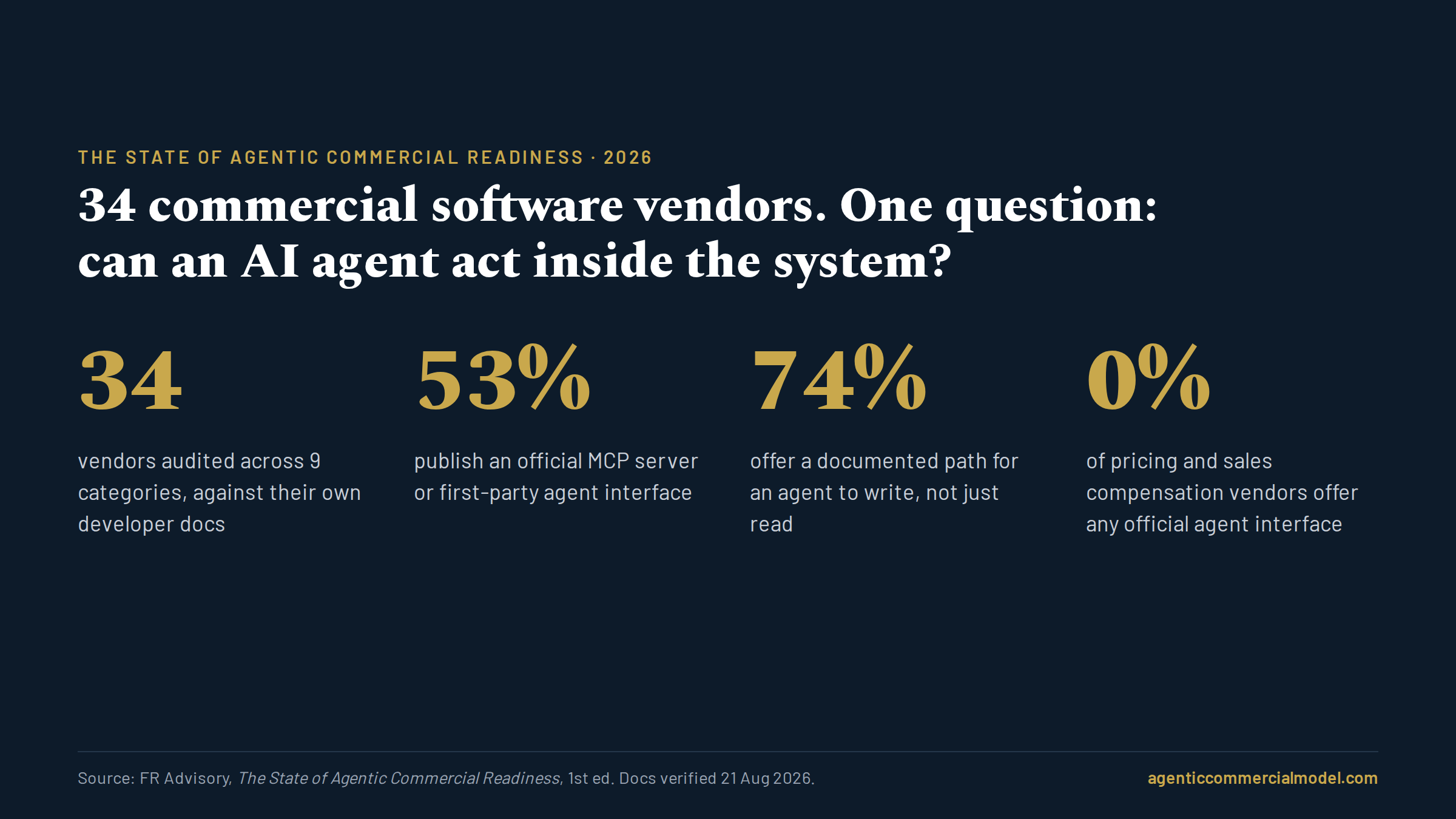
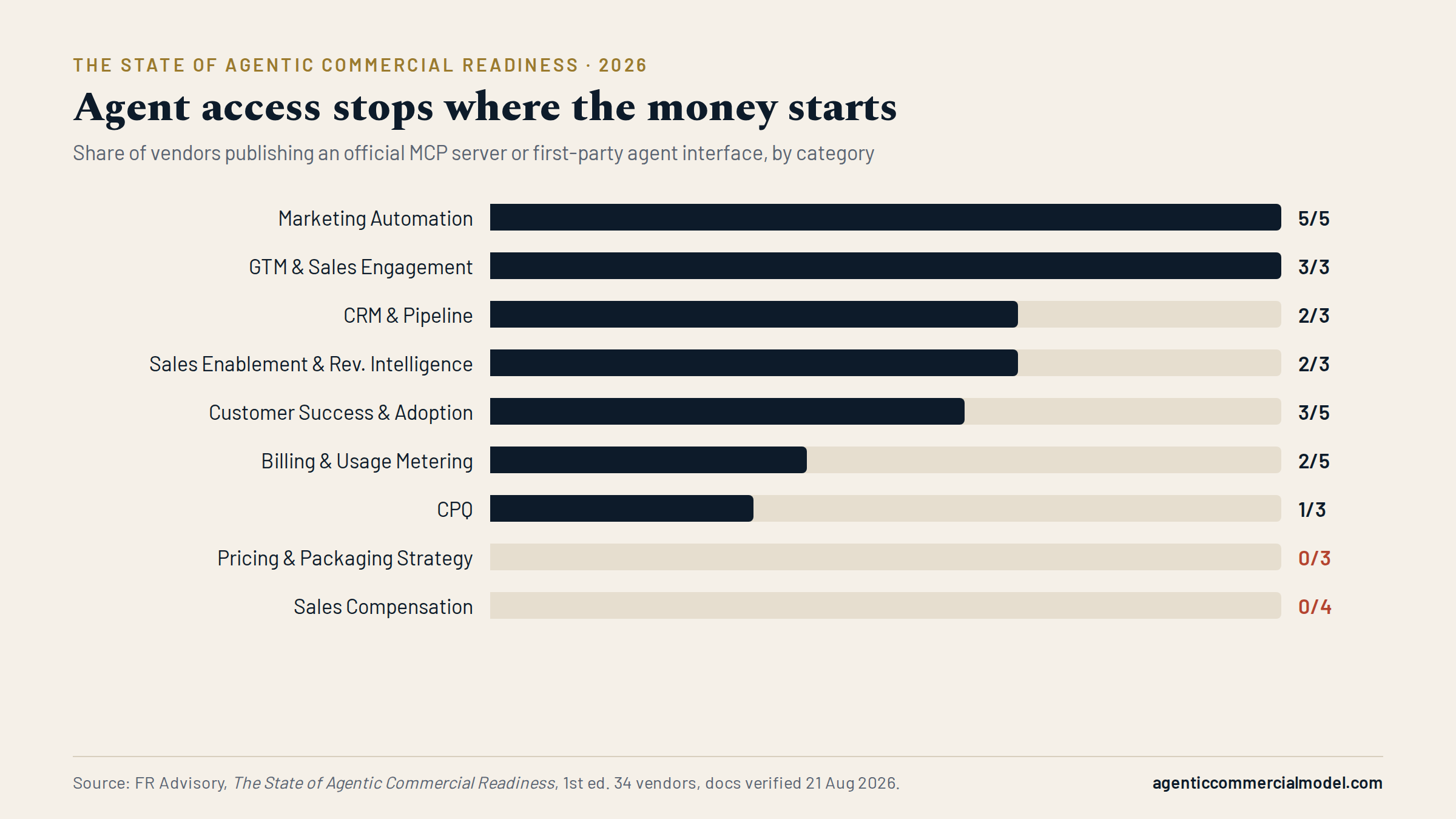
Agent access is not evenly distributed across the commercial stack. It is concentrated, almost perfectly, in the layers furthest from a P&L decision and absent from the layers closest to one. Marketing automation and outbound sales engagement (the tools that send emails, log activity, and book meetings) sit at 100% official MCP adoption. Pricing and packaging software and sales compensation platforms (the systems that decide what a customer pays and how a rep gets paid) sit at zero.
That is not a coincidence of engineering priority. It is a reasonable, almost defensible sequencing choice by every vendor in this registry, made independently and arriving at the same place: ship agent access first where a mistake costs an email that didn't need sending, and last where a mistake costs a mispriced deal or a comp plan paid out wrong. The problem is that the sequencing choice made independently by 34 vendors becomes, in aggregate, a structural gap: the exact two layers a business needs an agent ready commercial model to have covered are the two layers with no vendor coverage at all.
Even where an interface exists, access is often narrower than the MCP label implies. In Sales Enablement & Revenue Intelligence, two of three vendors publish an official MCP server, but one of them is documented as read only by design, and the write scope on the other is unconfirmed. An agent can look at your pipeline in these tools. It very often still can't act on it.
Readiness by category
Every vendor was checked against its own developer documentation, not its marketing copy, and scored on three questions: does an official MCP server exist, is there any documented API path with write access, and when was this last verified. The full vendor level evidence sits in the Agentic Tech Stack's registry; the roll up by category is below.
| Category | Layer | Official MCP | Note |
|---|
| Marketing Automation | L2 | 5 / 5 | Full adoption. ActiveCampaign, ClickFunnels, Customer.io, Klaviyo and Semrush all publish a first party interface. |
| GTM & Sales Engagement | L2 | 3 / 3 | Full adoption. Apollo.io, Clay and Outreach (shipped August 2026) all publish official access. |
| CRM & Pipeline | L9 | 2 / 3 | HubSpot and Pipedrive publish scope gated servers; the third vendor has no developer portal at all. |
| Customer Success & Adoption | L7 | 3 / 5 | Gainsight, Planhat and Vitally are official; one vendor's claim is press release only, unconfirmed in docs. |
| Sales Enablement & Revenue Intelligence | L4 | 2 / 3 | Official servers exist, but one is read only by design and the other's write scope is unconfirmed. |
| Billing & Usage Metering | L6+8 | 2 / 5 | Chargebee and Metronome ship official servers with production write access; the rest rely on REST APIs only. |
| CPQ | L3 | 1 / 3 | One official server (PandaDoc); the rest offer only third party MCP wrappers around a documented REST API. |
| Pricing & Packaging Strategy | L3 | 0 / 3 | Zero official interfaces. One vendor's MCP is a press release claim with no supporting documentation. |
| Sales Compensation & Incentive Mgmt | L5 | 0 / 4 | Zero official interfaces. Three of four have a documented write capable API; none has shipped an agent server. |
Reading the two zeroes together. Pricing & Packaging and Sales Compensation are not adjacent categories by accident: they are the two systems that jointly determine unit economics. No vendor has published an interface letting an agent touch either one. Until that changes, "agent native pricing" and "agent aware compensation" are things a business has to build internally, not buy off the shelf.
Readiness by layer
Mapping the registry onto all nine layers of the Agentic Commercial Model: including Organisation Design, which sits outside any vendor category because no piece of software fixes it. Each layer links through to the full breakdown: what it covers, why it's breaking now, and the essays and playbooks that address it.
01Not vendor addressable: no category maps to this layer at all.
02Marketing Automation (5/5) and GTM & Sales Engagement (3/3) official.
03CPQ at 1/3; Pricing & Packaging Strategy software at 0/3.
042/3 official, but effectively read only where it counts most.
05Sales Compensation & Incentive Management at 0/4 official.
06Billing & Usage Metering at 2/5 official, 5/5 with some write capable API.
07Customer Success & Adoption at 3/5 official.
08Shares Billing & Usage Metering coverage with layer six: same 2/5 official figure.
09CRM & Pipeline at 2/3 official.
What this means if you run one of these functions
If your GTM and marketing stack already has agent access, that's not a differentiator anymore: it's the baseline every competitor also has. The layers where you can still build an edge are exactly the ones this registry shows as uncovered: pricing, compensation, and the parts of revenue architecture and CS that depend on them. Buying software won't get you there yet, because the software mostly doesn't exist. That gap is what the nine layer model and the assessment underneath it are built to close, not by waiting for a vendor to ship the interface, but by rebuilding the commercial architecture around agentic delivery directly.
 Download key findings (PNG)
 Download category chart (PNG)